
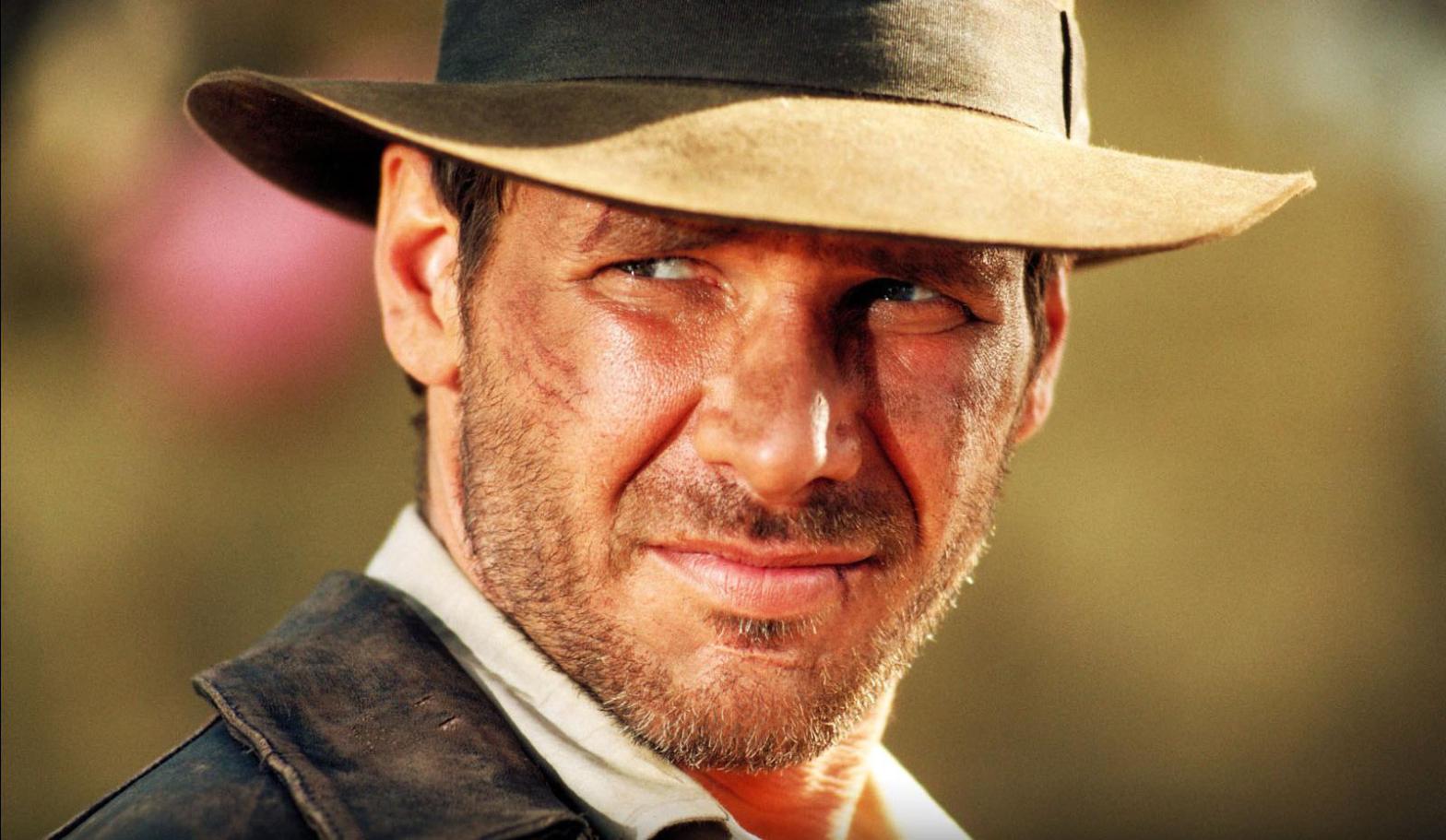
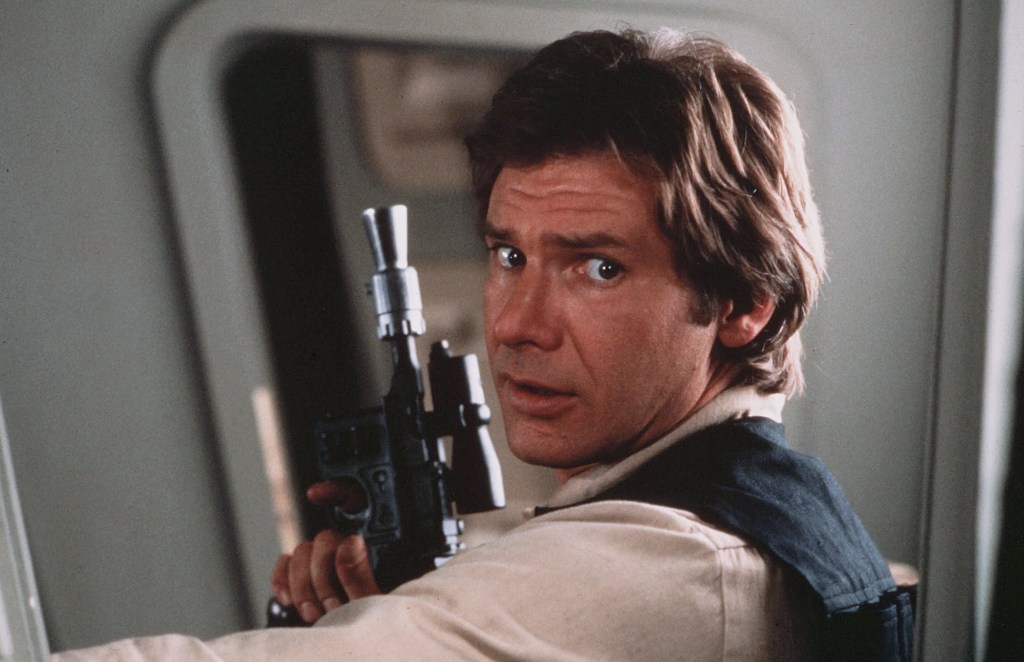
I typically publish these posts after we’ve lost the artist, but I didn’t want to wait that long to pay tribute to one of my favorite actors, the inimitable Harrison Ford. It would be impossible to overstate the importance of Ford to my generation (X, in case you’re new here) and to me personally. He appeared in two of the era’s most iconic franchises, Star Wars and Indiana Jones, and for his portrayal of Han Solo and Dr. Jones alone, Ford deserves a place in the movie hall of fame.
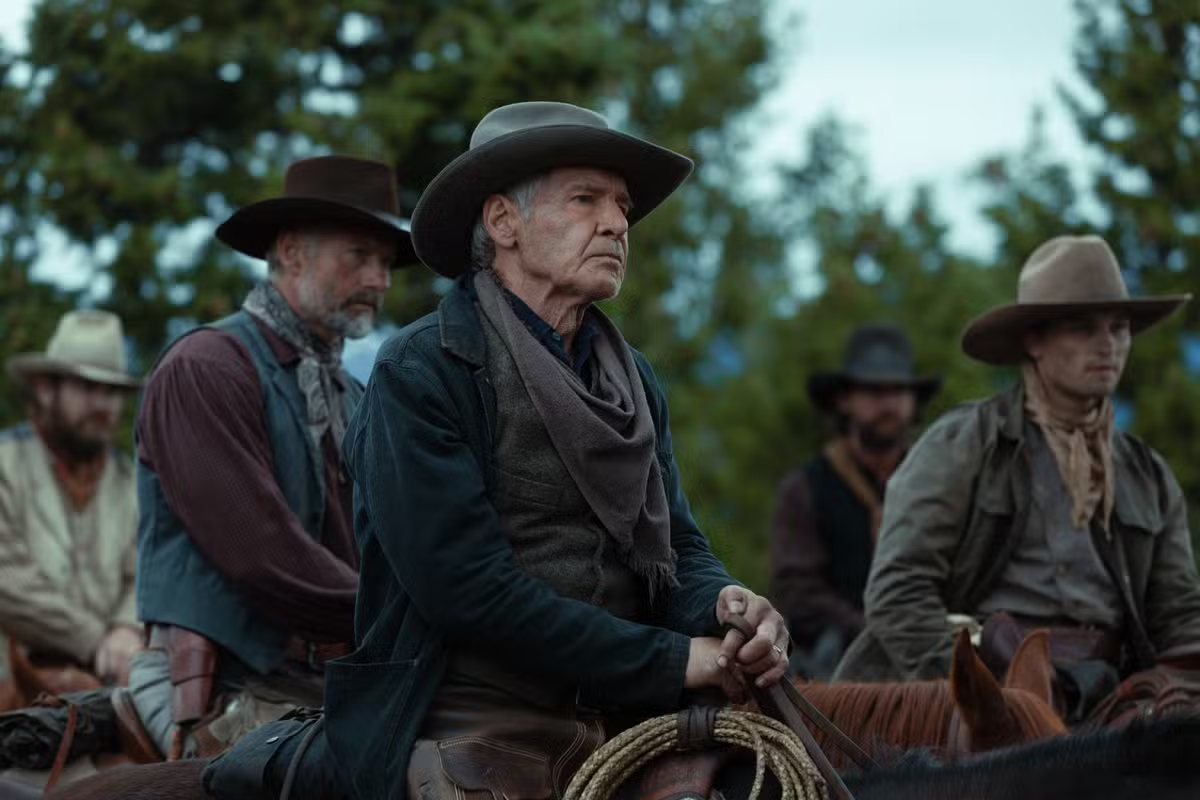
But there is so much more: American Graffiti, Apocalypse Now, Blade Runner, and The Fugitive, all stone-cold classics. Witness, for which Ford received his sole Academy Award nomination. Working Girl, his successful foray into screwball comedy. Jack Ryan. POTUS. Branch Rickey. More recently, Ford has taken on fewer film roles. He’s also found a new home on television, first in the Yellowstone prequel 1923, and then on Apple TV+’s critically acclaimed Shrinking, for which he has rightfully received numerous accolades. In my opinion, his performance as senior therapist (and Parkinson’s patient), Dr. Paul Rhoades, is his best acting yet. Ford also recently joined the MCU, taking over the role of Thaddeus Ross AKA Red Hulk from the late William Hurt.
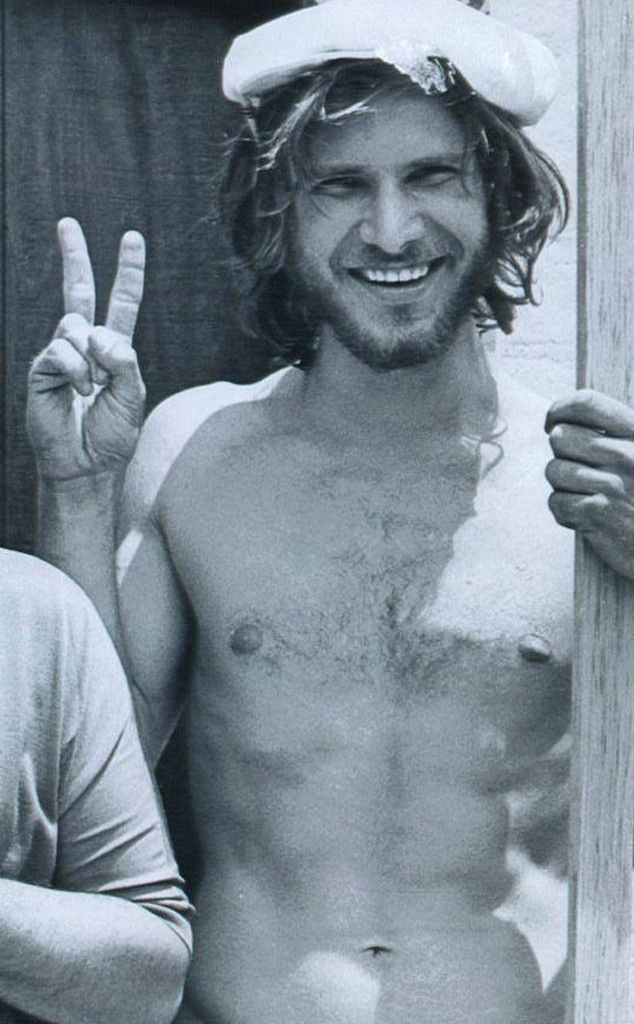
Harrison Ford was born on July 13, 1942, in Chicago and grew up in nearby Park Ridge. The son of an Irish-Catholic father and an Ashkenazi Jewish mother, Ford was a Boy Scout who achieved the second-highest rank of Life Scout (in 1989’s Indiana Jones and the Last Crusade, young Indy was depicted as a Life Scout in Ford’s honor).


After graduating from high school in 1960, Ford attended Ripon College in Wisconsin, majoring in philosophy and pledging the local chapter of Sigma Nu fraternity (and getting expelled for plagiarism four days before graduation). He took a drama class in his final semester to help conquer his shyness and was fully bitten by the acting bug. He spent the 1964 season doing summer stock before heading to Hollywood.

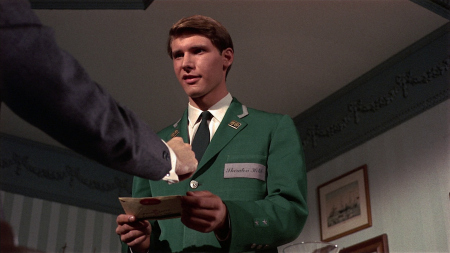
Ford quickly landed a contract with Columbia Pictures. He made his motion picture debut as an uncredited extra – a bellhop – in 1966’s Dead Heat on a Merry-Go-Round. By 1967, he had landed speaking roles in western films like A Time for Killing and Journey to Shiloh, as well as television series such as The Virginian and Ironside. Unhappy with the roles he was being offered, Ford became a self-taught carpenter to support his wife and two young children.
In 1973, Ford landed his big break when he was cast in George Lucas’s American Graffiti. It was a small role, but his professional relationship with Lucas would yield massive dividends a few years later when Lucas cast him as Han Solo in a tiny little movie called Star Wars (you may have heard of it?). Lucas introduced the actor to Francis Ford Coppola, for whom Ford did some carpentry work. Coppola also gave Ford minor roles in The Conversation and Apocalypse Now.
FUN FACT: Ford’s character in Apocalypse Now is named G. Lucas as a nod to George Lucas. Lucas spent four years developing Apocalypse Now, a loose adaptation of Joseph Conrad’s novel Heart of Darkness, before putting the project on hold to make American Graffiti and Star Wars. Francis Ford Coppola later acquired the rights to John Milius’s script, and Apocalypse Now became one of Coppola’s most iconic films.
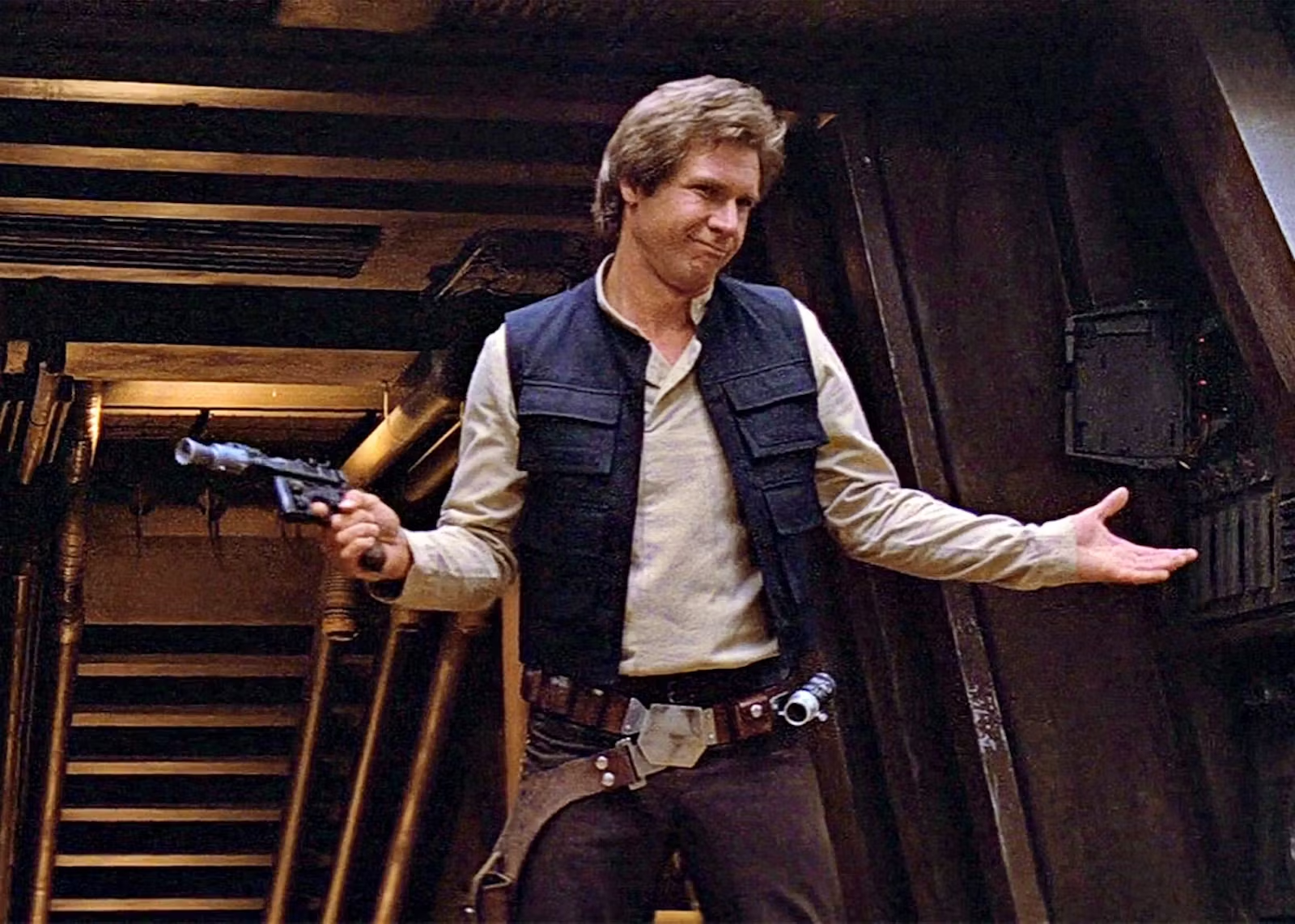

In 1980, Ford made his second appearance as Han Solo in The Empire Strikes Back and achieved what few actors do: he landed the leading role in a second iconic film franchise. Tom Selleck was the original choice to play Indiana Jones, but when CBS greenlit Magnum P.I., Selleck was forced to decline the role. Ford stepped in, and one of the most beloved characters in movie history was born.
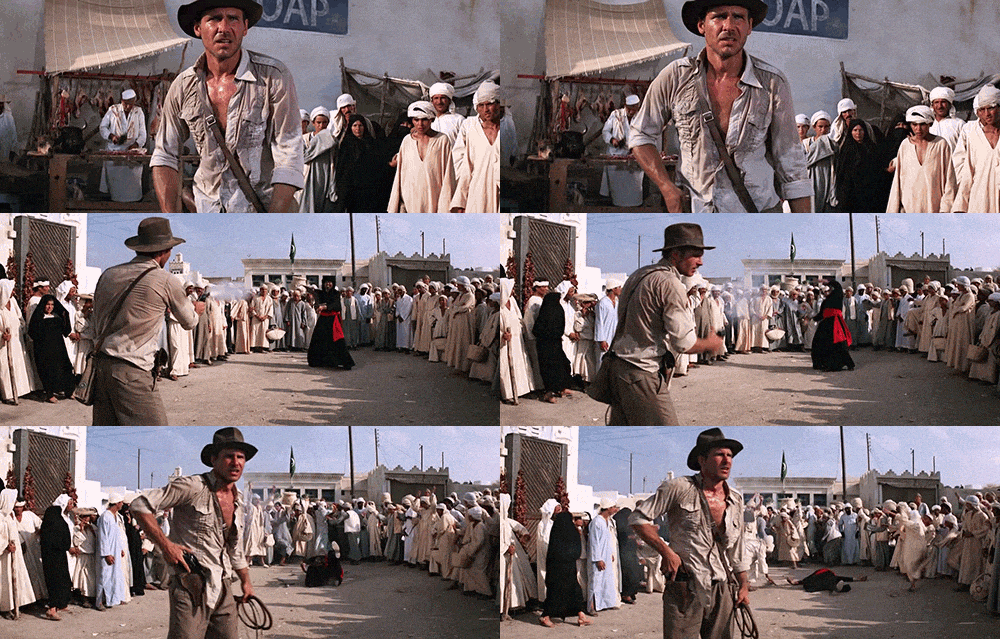
Between the Star Wars and Indiana Jones franchises, Ford was one of the most bankable stars of the 1980s. Not one to rest on his franchise laurels, Ford shone in SERIOUS DRAMAS™️ like Witness and The Mosquito Coast, as well as in genre films like Blade Runner and Frantic. He ended the decade with one of the most beloved sequels of all time (and my personal favorite Ford film), Indiana Jones and the Last Crusade.


In the 1990s, Ford fully leaned into the action genre that made him a star, with films such as Patriot Games, The Fugitive, Clear and Present Danger, and Air Force One. And while his 21st-century movie output has been a little spottier, duds like K-19: The Widowmaker, Hollywood Homicide, and Firewall failed to tarnish Ford’s reputation.
In the past decade, Ford has revisited his three most iconic roles: Han Solo in Star Wars: The Force Awakens, Rick Deckard in Denis Villeneuve’s gorgeous Blade Runner 2049, and our favorite archaeologist in Indiana Jones and the Dial of Destiny. But it’s his television work of the past few years – 1923 and, particularly, Shrinking – that’s garnering Ford some of the best reviews of his life, as well as nominations for Critics’ Choice, Golden Globe, Primetime Emmy, and Screen Actors Guild Awards. I’m not being hyperbolic when I say his performance in Shrinking is the best acting of Ford’s career (and is just generally one of the best shows on television right now).
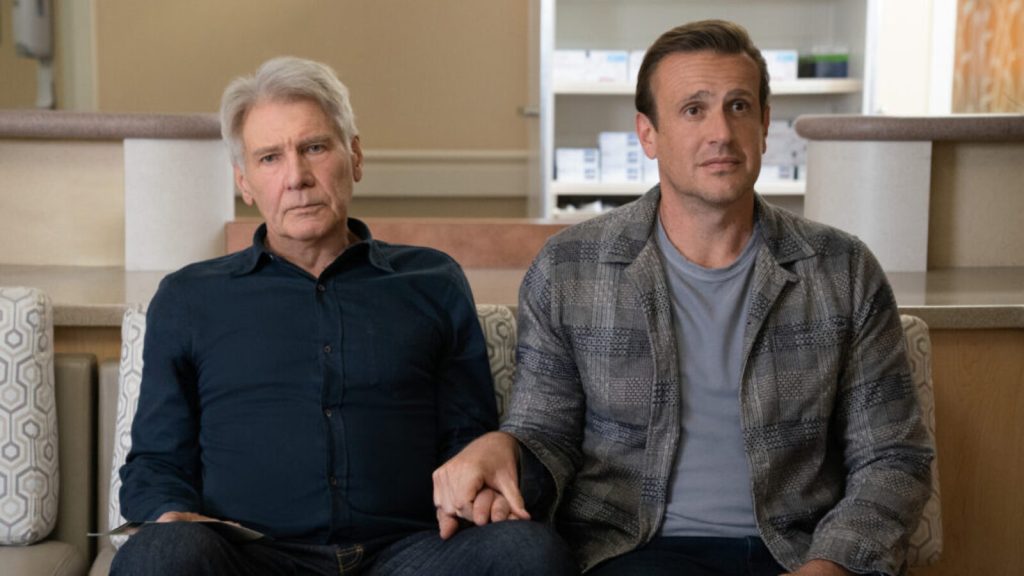
Ford is also a five-time dad, a pilot, a conservation activist, and a lifelong Democrat, as well as a renowned marijuana consumer (and seller – upon seeing Ford in Star Wars, Michelle Phillips exclaimed, “That’s my pot dealer!”). Ford and his spouse, Calista Flockhart, maintain a home base in the Brentwood neighborhood of Los Angeles, but their primary residence is Ford’s 800-acre ranch in Jackson, Wyoming.
Without further ado, here is a look at some of my favorite Ford performances, fun facts, and miscellany.
- American Graffiti

Ford’s role in American Graffiti was small, but it marked his first mainstream acting success. It introduced him to George Lucas, with whom he has shared a decades-long professional relationship. And it gave Ford his first opportunity to flash that million-dollar smile at movie audiences.
FUN FACT #1: Primarily making a living as a carpenter at that point, Ford accepted the role in American Graffiti with the caveat that he would not cut his hair to match the style of the 1950s, in case he received any offers for contemporary roles. In the end, it was decided that Ford would wear a Stetson to cover up his ’70s ‘do.
FUN FACT #2: American Graffiti is the first of seven films starring Ford that have been nominated for a Best Picture Oscar.
- The Frisco Kid
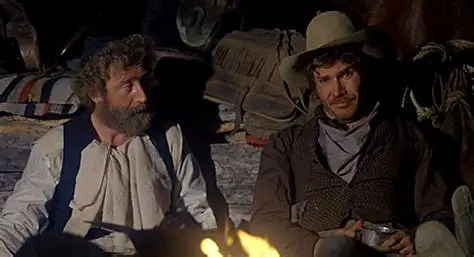
I was ten years old when I saw my first Harrison Ford movie, 1979’s Western comedy The Frisco Kid (I didn’t see Star Wars for the first time until a few years later). The film stars Gene Wilder as a Polish rabbi travelling across the country to the San Francisco synagogue where his new congregation awaits. Along the way, he meets bank robber Tommy Lillard (Ford) and the two forge a friendship as they flee a trio of bandits. Ford and Wilder are delightful together, and I was thoroughly entertained by The Frisco Kid.
- Raiders of the Lost Ark
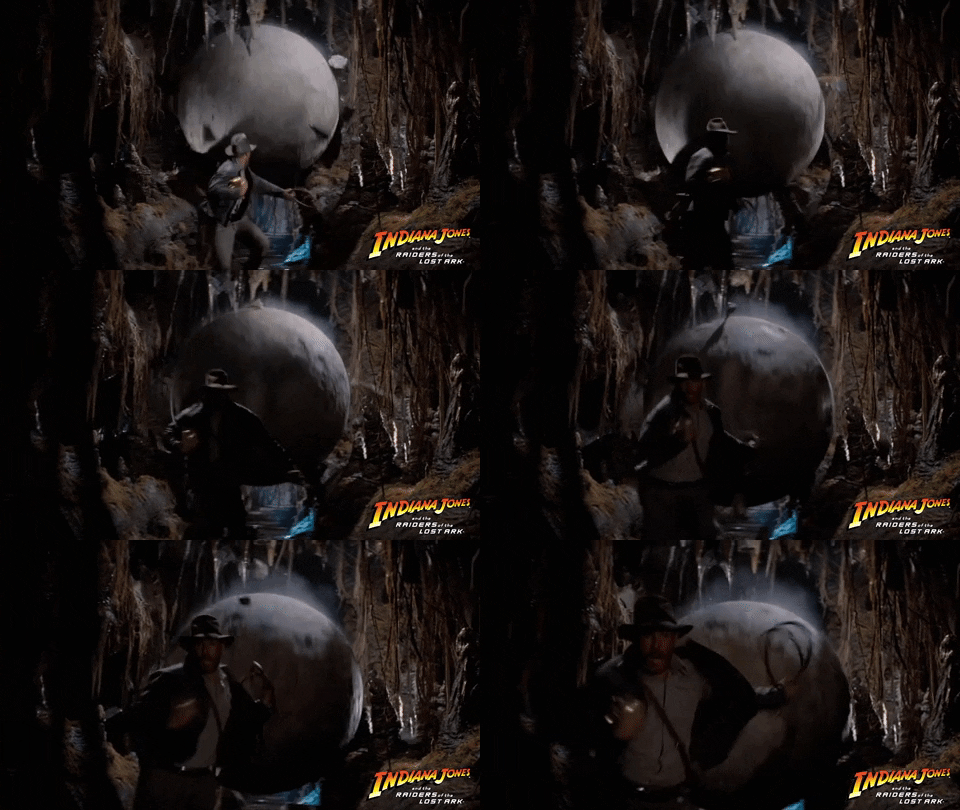
I turned 12 a few weeks before Raiders of the Lost Ark was released in 1981. It was the most thrilling (and, at times, terrifying) moviegoing experience of my life. From the electrifying opening sequence, in which archaeologist Indiana Jones outruns a fucking boulder, to the Nazi face-melting finale, Raiders is 115 minutes of pure movie magic. I was a Ford (and Spielberg) fan from that day forward.

FUN FACT #1: In George Lucas’s original draft, Indy’s last name was Smith instead of Jones.
FUN FACT #2: Paramount Pictures had low expectations for Raiders; CinemaScore polling showed little advance interest in the film, and Superman II was predicted to be the highest-grossing movie of the year. In the end, it wasn’t even close; Raiders earned almost twice as much as Superman II, which actually finished the year in a surprising third place behind On Golden Pond. Audiences gave the film an “A+”, the reviews were (mostly) rapturous, and Raiders was nominated for nine Oscars, including Best Picture and Best Director.
- Blade Runner

Ford’s most iconic role that isn’t Solo or Jones is Rick Deckard, the replicant hunter from Ridley Scott’s 1982 sci-fi masterpiece Blade Runner. Based on Philip K. Dick’s dystopian novel Do Androids Dream of Electric Sheep?, Blade Runner garnered mixed reviews and modest box office receipts but later developed a cult following. Acclaimed filmmakers such as Christopher Nolan, Denis Villeneuve, Guillermo del Toro, and Rian Johnson have cited Blade Runner as an influence on their work.
FUN FACT: In 2007, the Visual Effects Society named Blade Runner the second-most visually influential film of all time, with only Star Wars (1977) beating it.
- Witness
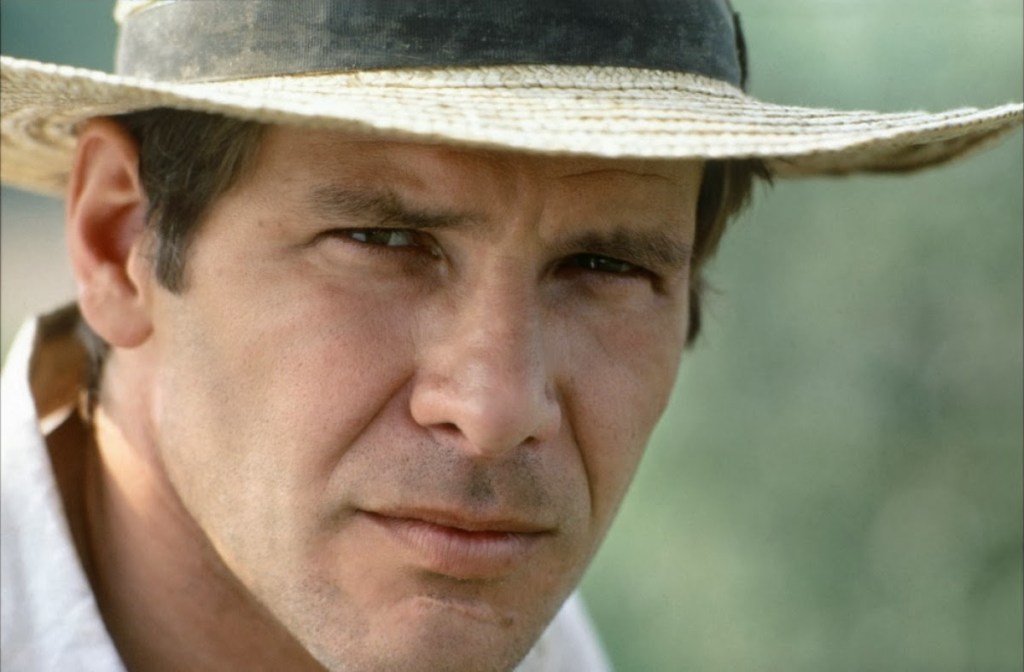
John Book is the only role for which Ford has been nominated for an acting Oscar. Witness received eight Academy Award nominations in all, including Best Picture and Best Director (Peter Weir), winning for Best Original Screenplay and Best Film Editing.
FUN FACT: Weir drew inspiration from the paintings of Dutch master Johannes Vermeer for the film’s composition and lighting, particularly for the scenes between Book and Rachel (Kelly McGillis) while Book recovers from his gunshot wound.
- Working Girl
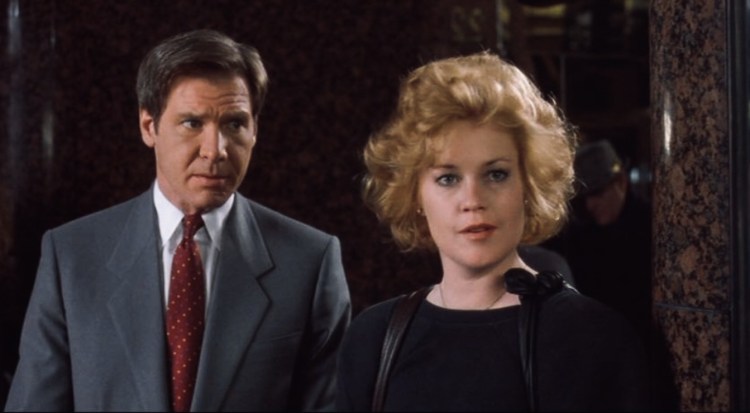
My husband and I rewatched Working Girl a few years ago, and aside from the gloriously cheesy ’80s hair and makeup, it has aged beautifully. Ford is at his most charming, and his chemistry with Melanie Griffith is lovely. Come Oscar time, Ford’s co-stars – Griffith, Sigourney Weaver, and Joan Cusack – were all acknowledged for their performances, with only Ford left off the list of nominees. But Ford had successfully conquered another subgenre, the screwball comedy – and he was about to star in one of the most beloved sequels of all time.
- Indiana Jones and the Last Crusade

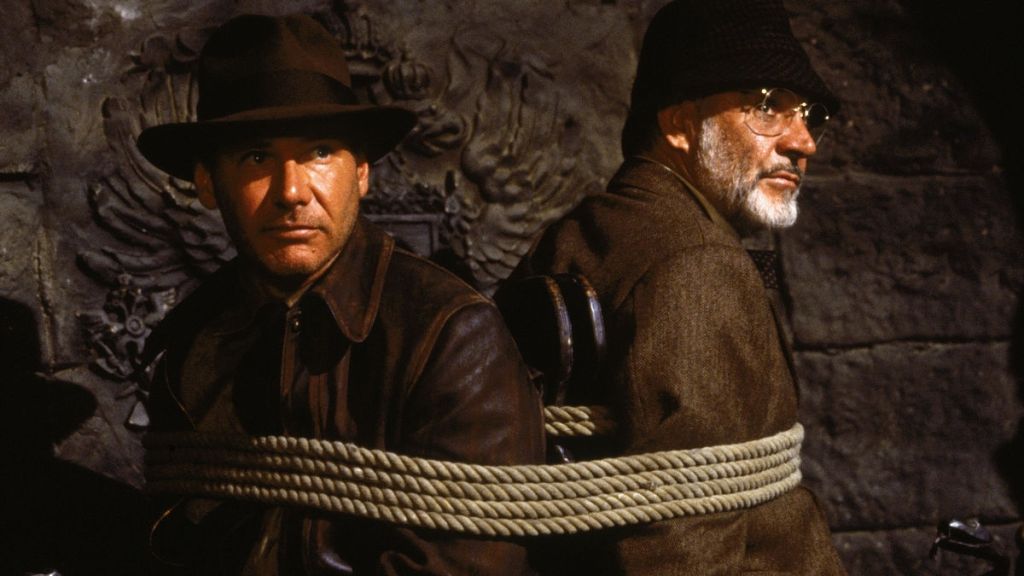
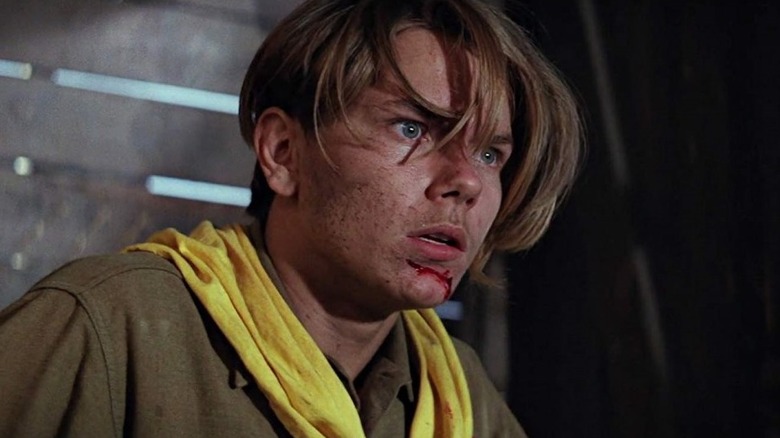
Raiders of the Lost Ark is the best Indiana Jones movie, but Last Crusade is my favorite. In fact, it’s my favorite Ford film, period. Movie audiences agreed, giving The Last Crusade an “A” CinemaScore and making it the highest-grossing film of 1989. Everything about it is pitch-perfect, from the opening sequence featuring River Phoenix as a young Indy to the Oscar-winning sound effects to the introduction of Sean Connery as Henry Jones Sr. Despite being just twelve years older than Ford, Connery was perfect for the role and a welcome addition to the franchise. His spiky chemistry with Ford is a highlight of the film; the dramatic denouement, which tests Indy’s skills – and his faith – brings the father/son storyline full circle. Absolute cinematic perfection.
FUN FACT #1: The dog’s name really WAS Indiana – he was George Lucas’s handsome AF Alaskan Malamute.

FUN FACT #2: Ford received his chin scar in a childhood car accident. One of my favorite moments in Last Crusade shows how young Indy got HIS scar, thanks to a circus train, a lion, and his signature whip.
- The Fugitive
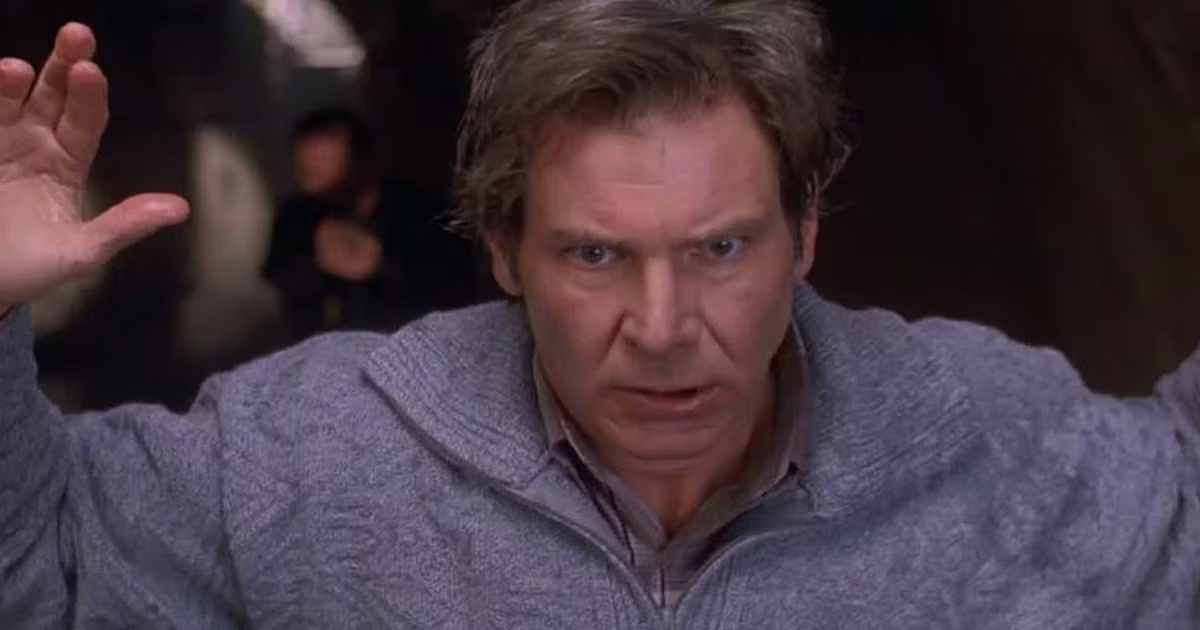
My favorite non-Indiana Jones Harrison Ford movie and the third-highest-grossing film of 1993 (after Jurassic Park and Mrs. Doubtfire), The Fugitive was also a critical success, garnering seven Academy Award nominations and a 96% rating on Rotten Tomatoes. Audiences surveyed by CinemaScore gave The Fugitive a rare “A+” grade. And although Best Supporting Actor Oscar winner Tommy Lee Jones received the lion’s share of the acclaim for his entertaining turn as grouchy U.S. Marshal Samuel Gerard, Ford’s thoughtful, understated performance as falsely accused Richard Kimble is the glue that holds The Fugitive together (well, that and those killer action sequences).
FUN FACT #1: The Fugitive‘s director, Andrew Davis, was born and raised on Chicago’s South Side, and the film has been praised for its use of the city as a backdrop. Cinematographer Michael Chapman, who received an Oscar nomination for his work, credits Davis; per Chapman, “A lot of it really feels like Chicago, because it just has a native’s eye to it. That’s Andy’s, not mine. He knew where to look.”
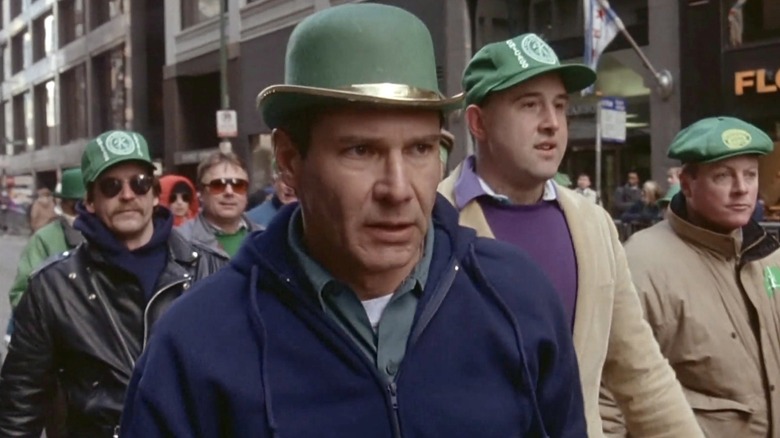
FUN FACT #2: The parade sequence was filmed during the actual Chicago St. Patrick’s Day parade, as were scenes for another 1993 feature, Michael Apted’s Blink.
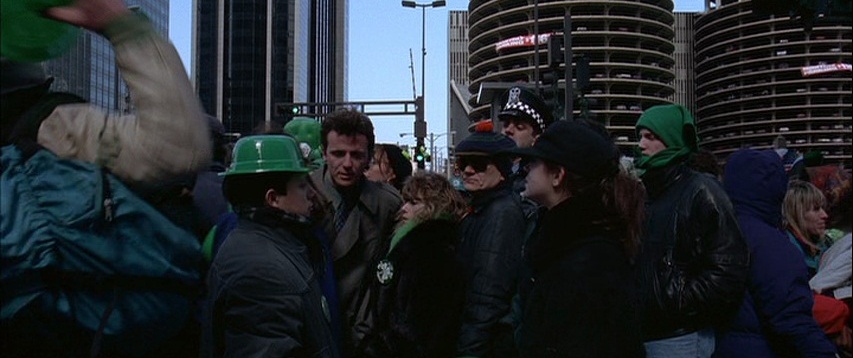
FUN FACT #3: The making of The Fugitive was chaotic, with scenes often rewritten on set the day of shooting. Because of Ford’s limited availability, Davis had just 10 weeks from the time filming was complete to the film’s August 6 premiere, an absolutely insane timeline that one editor couldn’t accomplish alone. Producer Peter MacGregor-Scott set up a suite of editing rooms at Warner’s Hollywood Studios, and a team of six editors worked around the clock to bring The Fugitive in on time. All six were nominated for the Academy Award for Best Film Editing; they lost – rightly – to Michael Kahn’s extraordinary work on Steven Spielberg’s Schindler’s List, but they certainly earned the award for “Fastest Film Editing”. Anyway, this is an entertaining look at the making of the movie from the Shit Show YouTube channel.
- Calponia harrisonfordi, Pheidole harrisonfordi, Tachymenoides harrisonfordi


Ford has been the namesake for multiple species. In 1993, arachnologist Norman I. Platnick named a species of spider after Ford to thank him for narrating a documentary for the Natural History Museum in London. In 2002, entomologist Edward O. Wilson named a new ant species in honor of the actor’s conservation work. Best of all, a new species of Peruvian snake was named for Ford in 2023.

- What Lies Beneath

Ford, who in person is charming and affable (if a little gruff), rarely plays the villain. As a psychopathic professor who murders his mistress when she threatens to expose their affair, Ford – ahem – kills it (though I still prefer him as a hero). A nifty Hitchcockian thriller with a supernatural twist, featuring a terrific Michelle Pfeiffer as the wife haunted by the dead mistress’s ghost, What Lies Beneath rules.
FUN FACT: What Lies Beneath was made during a break in the filming of Robert Zemeckis’s Cast Away; production for that film was suspended for a year while Tom Hanks lost fifty pounds and grew a beard. I’m not dissing Cast Away, but What Lies Beneath is definitely my favorite Zemeckis film of 2000.
- Star Wars: The Force Awakens

I was never the biggest Star Wars fan, but I was stoked for hubby and I to attend a screening of J. J. Abrams’ The Force Awakens, the seventh chapter in the Skywalker Saga, especially when I learned that Ford would be reprising his role as Han Solo. OG characters like Leia, Chewbacca, R2-D2, and C-3PO returned, as well. The Gen-X nostalgia factor was off the charts there.
FUN FACT: Ford lobbied George Lucas to have Han Solo killed off in 1983’s Return of the Jedi, feeling that “[Han’s] sacrifice for the other characters would lend gravitas and emotional weight.” More than thirty years later, Ford finally got his wish with The Force Awakens. And although it wasn’t a huge surprise, Han’s death at the hands of his and Leia’s son Ben AKA Kylo Ren was still gut-wrenching.
- 2019 Climate Change Speech
Ford is vice-chair of the environmental nonprofit Conservation International and a fervent conservationist and climate change activist. This rousing speech, from 2019’s Global Climate Action Summit, perfectly highlights his passion for the cause. How can you not be inspired by this man?
- Shrinking
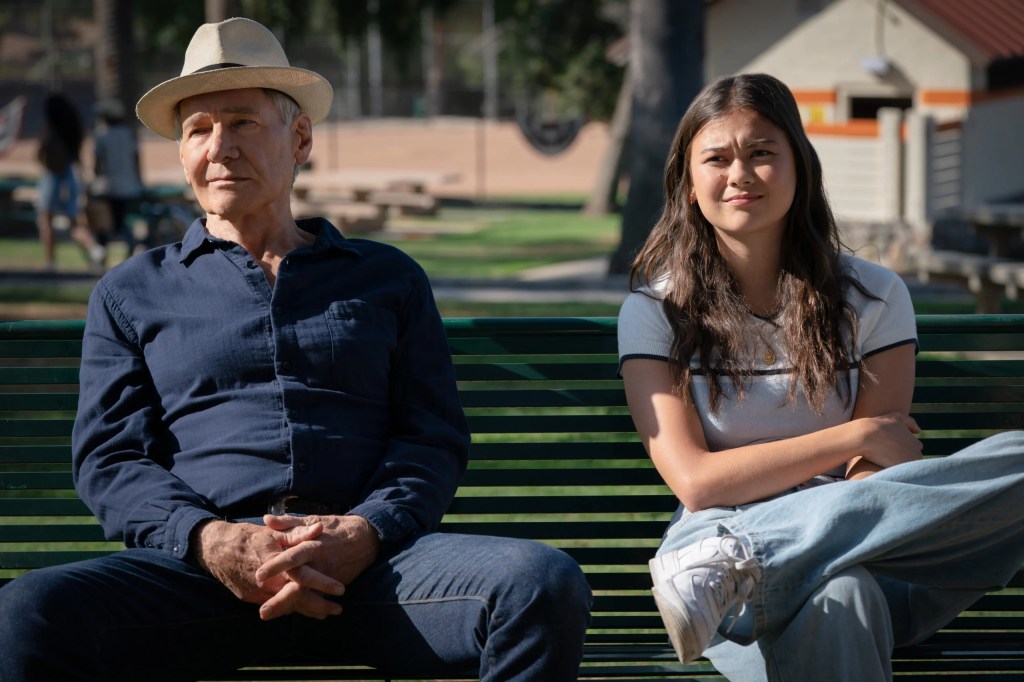
There aren’t enough superlatives to describe the Apple TV+ dramedy Shrinking. Equal parts hilarious and heartbreaking, Shrinking earns every laugh and every tear. The entire cast – star and co-creator Jason Segel, the peerless Jessica Williams, the ageless Christa Miller, Ted McGinley, and Wendie Malick, just to name a few – knock it out of the park episode after episode. But there’s a special place in my heart for Harrison Ford’s Dr. Paul Rhoades, a senior therapist and oft-exasperated mentor to our grief-stricken protagonist who has recently learned he has Parkinson’s disease. Ford’s poignant performance is note-perfect, and earned him numerous accolades, including his first ever Primetime Emmy Award nomination.
























































 PB & Julie + Julie C. Trivia