

On Saturday, July 13, 1985, an estimated 1.9 billion people across the globe gathered around their television sets and radios for Live Aid, a benefit concert for famine relief in Ethiopia. An additional 150,000 saw the event live from Wembley Stadium in London and JFK Stadium in Philadelphia.
The roots of Live Aid go back to the fall of 1984 when the BBC aired a series of reports on the famine in Ethiopia. Watching those reports was Bob Geldof, then best known as the lead singer of The Boomtown Rats. Geldof was inspired (along with Ultravox’s Midge Ure) to arrange for a group of all-star UK artists (collectively known as Band Aid) to record a single for famine-relief charity. The result was “Do They Know It’s Christmas?”, an undeniably catchy slice of cheese.
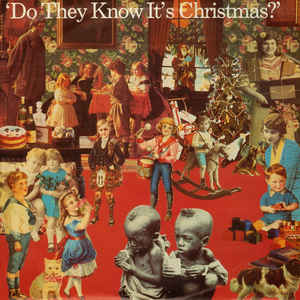

“Do They Know It’s Christmas?” was well-intentioned but cringe-worthy (‘Tonight thank God it’s them instead of you’? YIKES). Regardless, the single was a smash; “Do They Know It’s Christmas?”, which debuted at #1 in the UK, sold 2.5 million copies in the US and 11.7 million copies worldwide. The single also spawned an equally well-intentioned – and equally cringey – US version, co-written by Lionel Richie and Michael Jackson and credited to USA for Africa, called “We Are the World”.

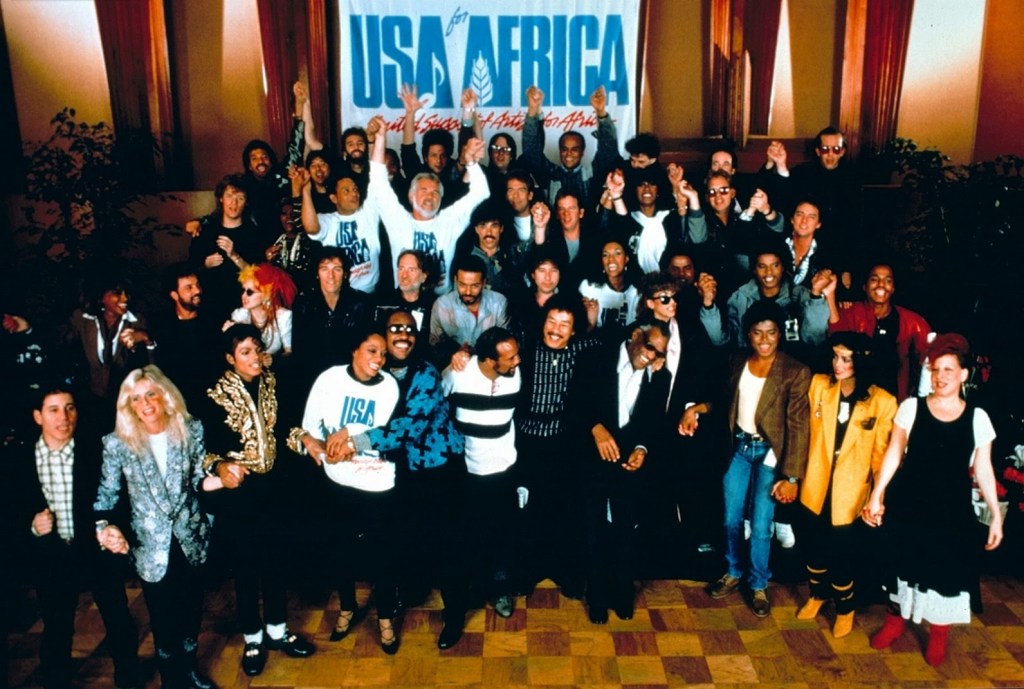
The success of Band Aid and USA for Africa inspired Geldof and Ure – on the suggestion of Culture Club’s Boy George – to organize a benefit concert to be held on two continents. The idea was to use satellites to bounce back and forth between the two locations, so music was constantly playing. Geldof and Ure hired promoters Harvey Goldsmith and Bill Graham to help organize the event and set about enlisting artists (several prominent musicians, including Michael Jackson, Bruce Springsteen, and Prince, declined for various reasons). Venues were selected. Television and radio broadcasting rights were secured.
The show kicked off at noon in London, 7 am EDT. When the lights went down on JFK, the music had been playing for sixteen hours.
My summer job that year was picking berries at a farm for 50 cents a quart. I had to work that morning, but we had the radio tuned to the event, and I was home by early afternoon to catch the rest of the broadcast. I don’t really recall the concert feeling life-changing at the time. As with any live event, there were memorable and not-so-memorable performances (or ones that were memorable for all the wrong reasons). This list includes a few of each.
- Phil Collins
Phil Collins was undoubtedly the Live Aid MVP. The only artist to appear at both locations, Collins played at Wembley, took the Concorde across the Atlantic, then did a set at JFK. He also assisted Sting, Eric Clapton, and Led Zeppelin (see next entry) during their performances.
FUN FACT: Collins was under the impression that other artists would be making the transcontinental trek with him and was mortified to learn he’d be the only one.
- Led Zeppelin
Live Aid was the first time the surviving members of Led Zeppelin played together since the death of drummer John Bonham in 1980. It…didn’t go well. Their set was disjointed, instruments were out of tune, and Robert Plant’s voice was ragged and tired. Jimmy Page tried to throw guest drummer Phil Collins under the bus, suggesting that Collins didn’t know his part, but honestly, Collins is only a fraction of the problem here.
- Dire Straits
Dire Straits was a massively popular band in the summer of 1985, thanks to their album Brothers in Arms and its #1 single, “Money for Nothing”. The song’s success was due in part to an assist from Sting, who provided the background vocals, including the iconic “I Want My MTV” (sung to the tune of The Police’s “Don’t Stand So Close to Me”). Sting pitched in to help when Dire Straits took the stage at Live Aid, and the result did not disappoint.
- Madonna
Madonna was the biggest pop star on the planet in 1985, thanks to Like A Virgin. The world could not get enough of Madonna. *I* could not get enough of Madonna. I’d just seen her in concert for the first time, at the Detroit leg of The Virgin Tour; the woman puts on a hell of a show. Madonna was introduced at Live Aid (hilariously) by Bette Midler, who alluded to the recent scandal involving nude photos of Madonna taken several years earlier appearing in Playboy and Penthouse magazines. Madonna played along, telling the crowd imploring her to take off her jacket (it was 95 degrees in Philly that day), “I ain’t taking shit off today”, before launching into her dance-party hit “Holiday” – and getting the audience on their feet.
- David Bowie
When I started working on this piece, I knew I needed to ask my bestie if she had any specific memories from that day (she and I didn’t meet until eight years after Live Aid took place). She first said how Queen gave her goosebumps (see the final entry on this list). Then she said, “David Bowie singing ‘Heroes'”. Bowie had the misfortune of following Queen, but if ever there was a performer who could rise to the occasion, it was Bowie. He had the audience in the palm of his hand, and those of us at home knew we were watching something very special.
- Bob Dylan with Keith Richards and Ron Wood
Bob Dylan caused a bit of a stir when he told the audience he wished some of the money being raised that day could go to struggling farmers in the US. Bob Geldof was angry at Dylan for his remarks, but the seeds were sown for Farm Aid, which took place two months after Live Aid. Dylan’s set was a bit of a mess; at one point, a string broke on his guitar, so Wood passed his over and played air guitar until someone could bring him another one. But when we talk about Dylan and Live Aid, it generally concerns his pre-performance comments.
- U2
U2 were not yet superstars in 1985, but Live Aid helped launch them into the stratosphere. Their performance that day is the stuff of legend: a planned third song, “Pride (In the Name of Love)”, had to be jettisoned after their second song, “Bad”, turned into an eleven-minute opus. Turns out Bono was looking for a young woman to come up to the stage and dance with him, as was his custom. But the crowd was surging, and Bono helped security pull a few people to safety, one of whom, Kal Khalique, would later tell The Sun that Bono had saved her life (see the 7:20 mark of the video below). The Edge, Larry Mullen, and Adam Clayton were purportedly angry at Bono, as he disappeared from their view, leaving them to repeat the same few bars of the song for several minutes. It wasn’t until later that they – and the rest of the world – fully understood what had happened.
- Paul McCartney
The concert’s promoters desperately wanted at least one of the surviving Beatles – preferably Paul – to play; Paul was hesitant, as he hadn’t performed live since the death of John Lennon five years earlier, but “the management” (McCartney’s children) insisted he play. Not wanting to deal with a “Beatles reunion” scenario, George Harrison and Ringo Starr opted not to participate. McCartney only performed one song, but it was the perfect choice. Technical difficulties prevented the folks at Wembley from hearing the song’s first two minutes, but it mattered little – by the end of “Let It Be”, all 72,000 people in the stadium were singing along.
- Black Sabbath featuring Ozzy Osbourne
Instead of rehearsing, the reunited band reminisced about the old days and went to the bar to get drunk. They took the stage at JFK at 9:52 am, still hungover (or possibly drunk again, depending on which account you read). Either way, their performance was a disaster.
- Elton John
Elton John had the longest set of the day, coming in at about 32 minutes. He sang one hit after another – “Rocket Man”, “Bennie and the Jets”, “I’m Still Standing”. He also got some help from Kiki Dee and George Michael on “Don’t Go Breaking My Heart” and “Don’t Let the Sun Go Down on Me”, respectively (Andrew Ridgeley, Michael’s Wham! bandmate, was consigned to singing background vocals). The crowd ate it up.
- Duran Duran
Oof.
- Band Aid/USA for Africa
Each show ended with the song that started it all: “Do They Know It’s Christmas?” in London and “We Are the World” in Philadelphia. It’s all fairly predictable, but hoo boy when Patti Labelle starts belting, you kind of forget everything else.
- Queen
Queen was not the top act on this ticket, but Freddie Mercury and company brought the house down. When the dust settled, many fans agreed that their set was not only the highlight of the day but the greatest rock performance EVER. If you have twenty minutes, it’s worth watching their full performance.
You can listen to/watch the Live Aid performances in several ways. Here are a couple of suggestions. You can listen to the complete setlist on Spotify:
Or you can subscribe to the Live Aid YouTube channel here:
 PB & Julie + Julie C. Trivia